
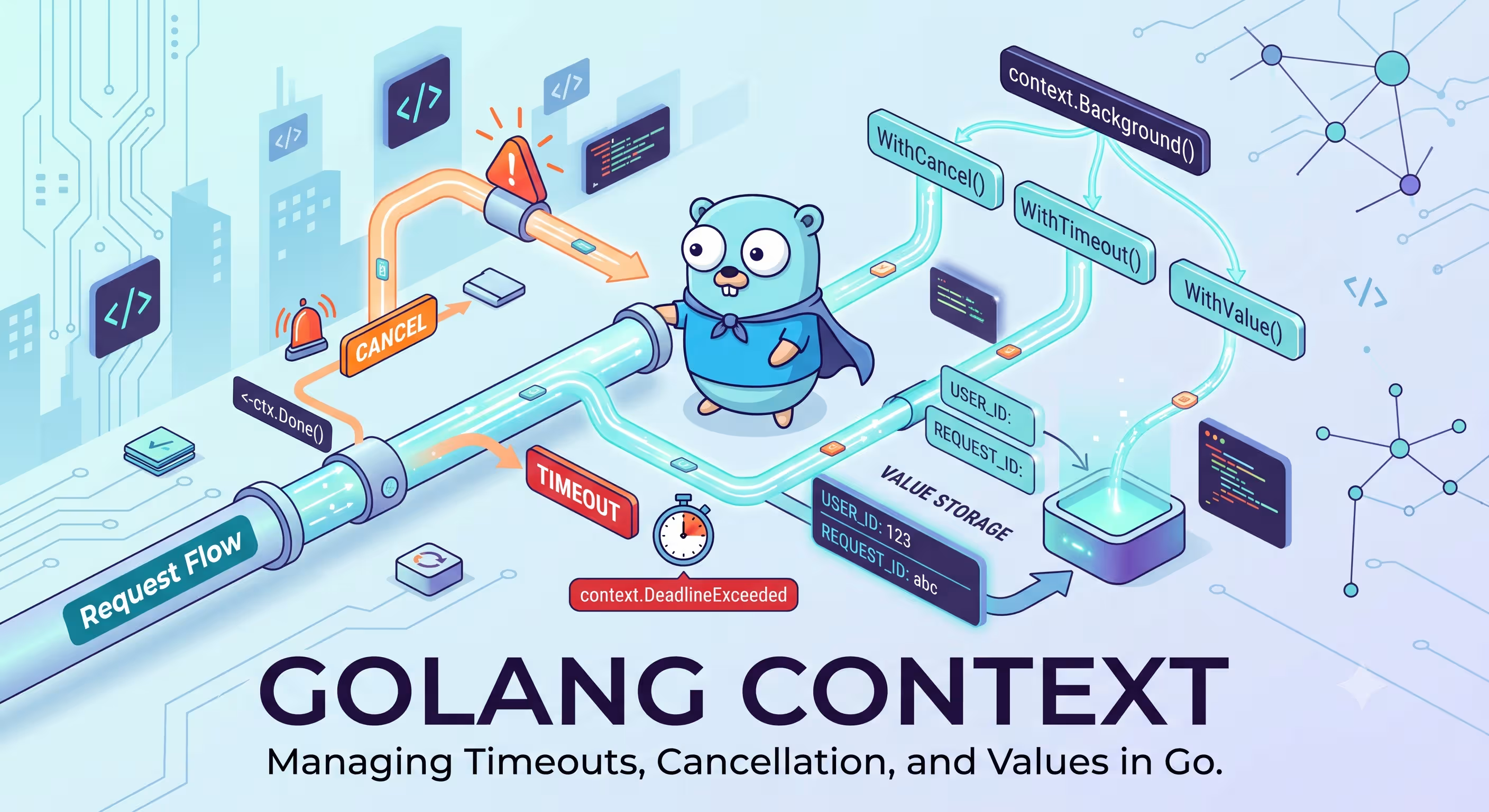


If you've spent any amount of time writing Go (Golang), you've likely encountered the context package. It's ubiquitous in Go's standard library and in popular third-party packages, especially when dealing with HTTP servers, database queries, and concurrent operations.
But what exactly is a context, and why do we need it?
In this post, we'll dive deep into the context package, explaining its purpose and how to use its various functions effectively.
What is Context for?
In Go, the context package serves two primary purposes:
- Cancellation and Timeouts: It provides a mechanism to propagate cancellation signals and deadlines across API boundaries and goroutines. If a user cancels an HTTP request, or a database query takes too long, you want to be able to abort the operation gracefully to free up resources.
- Request-Scoped Data: It allows you to pass request-scoped values (like authentication tokens, request IDs, or tracing information) down the call stack safely without having to pass them as explicit parameters to every single function.
The context.Context Interface
At the core of the package is the Context interface itself. If you look at the Go source code, it is defined like this:
1type Context interface { 2 Deadline() (deadline time.Time, ok bool) 3 Done() <-chan struct{} 4 Err() error 5 Value(key any) any 6}
Understanding these four methods is key to mastering context:
Deadline(): Returns the time when work done on behalf of this context should be canceled. If no deadline is set,okisfalse.Done(): Returns a channel that's closed when work done on behalf of this context should be canceled. This is the core mechanism you use insideselectstatements to listen for cancellation signals.Err(): Returns an error explaining why theDone()channel was closed (e.g.,context.Canceledorcontext.DeadlineExceeded). It returnsnilifDoneis not yet closed.Value(key): Returns the value associated with this context for a specific key, ornilif no value exists.
Creating the Root Context
Every context tree must start somewhere. Go provides two functions to create a root context:
context.Background()
This is the most common way to start a context. It returns an empty context that is never canceled, has no values, and has no deadline. You typically use context.Background() at the highest level of your application, such as in main(), init(), or tests.
1package main 2 3import ( 4 "context" 5 "fmt" 6) 7 8func main() { 9 ctx := context.Background() 10 // You now have a root context to pass around! 11 fmt.Println(ctx) 12}
context.TODO()
context.TODO() also returns an empty context. However, it serves as a placeholder. You should use context.TODO() when you are unsure which context to use, or if the surrounding function has not yet been updated to accept a context parameter. It signals to other developers (and static analysis tools) that a proper context should eventually be provided here.
Deriving Contexts
The real power of context comes from creating "derived" contexts from the root context. When a parent context is canceled, all of its derived (child) contexts are canceled automatically.
1. context.WithCancel()
context.WithCancel(parent) returns a copy of the parent context along with a cancel function. Calling the cancel function sends a cancellation signal to the context's Done channel.
1package main 2 3import ( 4 "context" 5 "fmt" 6 "time" 7) 8 9func doWork(ctx context.Context) { 10 for { 11 select { 12 case <-ctx.Done(): 13 fmt.Println("Work canceled!") 14 return 15 default: 16 // Do some work... 17 fmt.Println("Working...") 18 time.Sleep(1 * time.Second) 19 } 20 } 21} 22 23func main() { 24 ctx, cancel := context.WithCancel(context.Background()) 25 26 go doWork(ctx) 27 28 // Let the worker run for 3 seconds, then cancel it 29 time.Sleep(3 * time.Second) 30 cancel() 31 32 // Wait for the goroutine to finish printing 33 time.Sleep(1 * time.Second) 34}
2. context.WithTimeout() and context.WithDeadline()
These are extremely useful for operations that shouldn't take forever, like network requests or database queries.
context.WithTimeout(parent, duration)cancels the context after a specific duration (e.g., 2 seconds).context.WithDeadline(parent, time)cancels the context at a specific time (e.g., at 5:00 PM).
1package main 2 3import ( 4 "context" 5 "fmt" 6 "time" 7) 8 9func fetchUserData(ctx context.Context) { 10 // Simulate a slow database query 11 select { 12 case <-time.After(5 * time.Second): 13 fmt.Println("Data fetched successfully") 14 case <-ctx.Done(): 15 fmt.Println("Query aborted:", ctx.Err()) // Prints: context deadline exceeded 16 } 17} 18 19func main() { 20 // The query must complete within 2 seconds 21 ctx, cancel := context.WithTimeout(context.Background(), 2*time.Second) 22 defer cancel() // Always defer cancel to prevent context leaks! 23 24 fetchUserData(ctx) 25}
Note: Always call defer cancel() when creating derived contexts to ensure resources are cleaned up promptly, even if the operation finishes before the timeout.
3. context.WithValue()
This is used to pass request-scoped data down the call graph.
1package main 2 3import ( 4 "context" 5 "fmt" 6) 7 8type keyType string 9const userIDKey keyType = "userID" 10 11func processRequest(ctx context.Context) { 12 userID := ctx.Value(userIDKey) 13 fmt.Printf("Processing request for user: %v\n", userID) 14} 15 16func main() { 17 ctx := context.WithValue(context.Background(), userIDKey, "user-12345") 18 processRequest(ctx) 19}
Best Practice: Never use string types directly as keys for context.WithValue. Always define a custom unexported type (like keyType string above) to prevent key collisions between different packages.
Best Practices Summary
When working with context in Go, keep these golden rules in mind:
- Pass by Value: Always pass
context.Contextas a value, not a pointer. - First Argument: By convention,
context.Contextshould always be the first parameter of a function, usually namedctx(e.g.,func DoSomething(ctx context.Context, arg string)). - Don't store in Structs: Contexts are designed to flow through your application on a per-request basis. Avoid storing them inside structs; pass them explicitly to the methods that need them instead.
- Don't use
TODOpermanently: Treatcontext.TODO()as technical debt. Replace it with a proper context as soon as possible. - Always cancel: Always
defer cancel()when usingWithCancel,WithTimeout, orWithDeadlineto avoid resource leaks.
Mastering the context package is a rite of passage for Go developers. Once you understand how to wield it, your concurrent code will become much more robust, predictable, and clean!